Skip to the patient guide
24/7 CARE HELPLINE +91 9807 55 6789 Banjara Hills Madeenaguda

Trigeminal Neuralgia PainUnderstand the pattern.

Brief, sudden shocks of facial pain can make ordinary moments difficult. Learn how to describe an attack, what an assessment may look for and which care options you can discuss.

Article credits · Clinical review pending
Ivory anatomical teaching model showing three schematic facial nerve regions
Facial sensation · teaching illustration

Describe the timingNotice the length and number of bursts.

Explain the triggerRecall what happened just before it started.

Choose care togetherBring priorities and questions to the visit.

01THE ATTACK / WHAT TO NOTICE

Follow the sequence.Bring the detail.

Timing, location and what brought on the pain help a clinician distinguish trigeminal neuralgia from other causes of facial pain.

02 / During

A sudden, brief shock

Pain is often severe and shooting, usually on one side. An individual attack can last from a fraction of a second to about two minutes. Bursts can occur repeatedly.

Where did you feel it, and how long did a burst last?

02ANATOMY / FACIAL SENSATION

One nerve.Three facial regions.

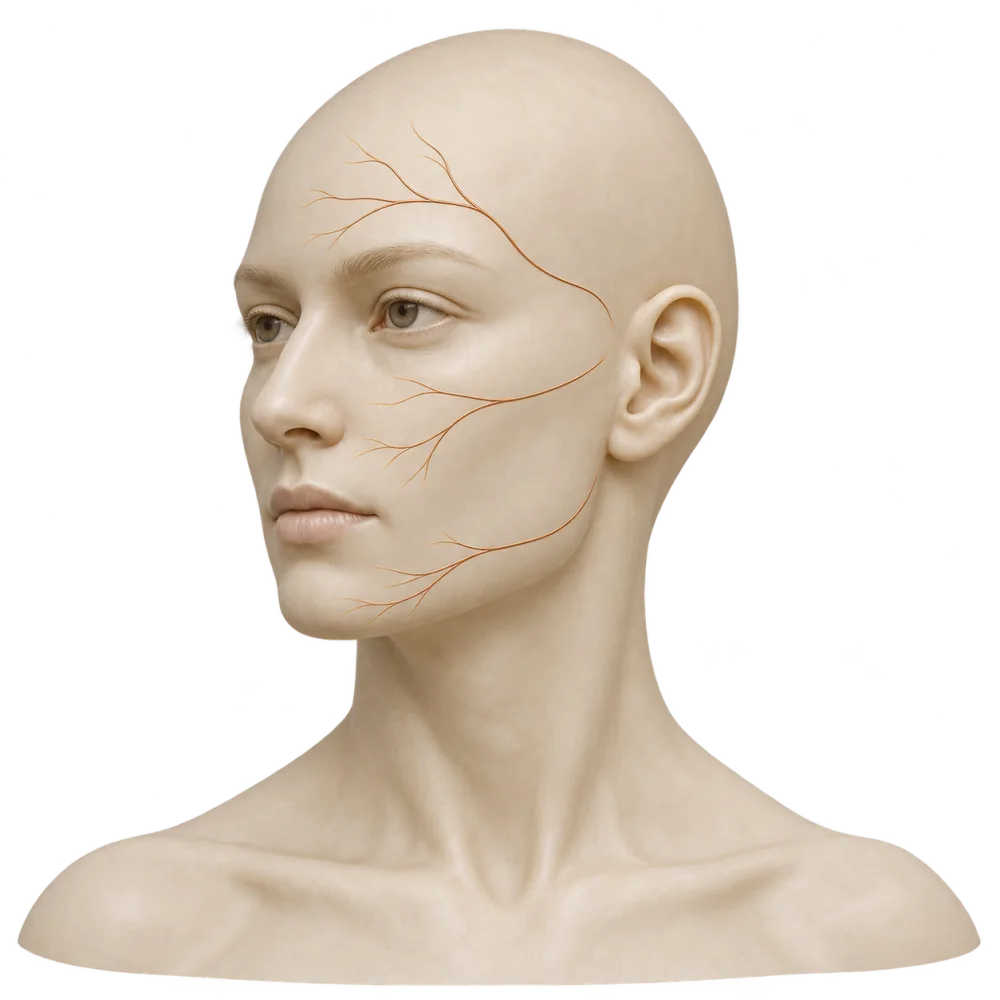
The trigeminal nerve carries much of the sensation from the face. Explore a branch to learn what it serves.

Three-quarter face model with three schematic paths across the forehead, cheek and jaw
Schematic facial regions. Boundaries overlap between people.

BRANCH 02

Cheek and upper jaw

The maxillary branch carries sensation from the middle of the face, including the upper lip and upper teeth.

A region helps describe your symptoms. Examination and the attack pattern help determine the cause.

Read all three branch explanations
V1 · Forehead
The ophthalmic branch carries sensation from the forehead and areas around the upper eyelid and eye.
V2 · Cheek
The maxillary branch carries sensation from the middle of the face, including the upper lip and upper teeth.
V3 · Lower jaw
The mandibular branch carries sensation from the lower lip, chin and lower teeth. It also supplies muscles used to chew.

03MECHANISM / AT THE NERVE ROOT

Similar attacks.Different explanations.

A specialist uses the history, examination and imaging to decide which subtype best fits.

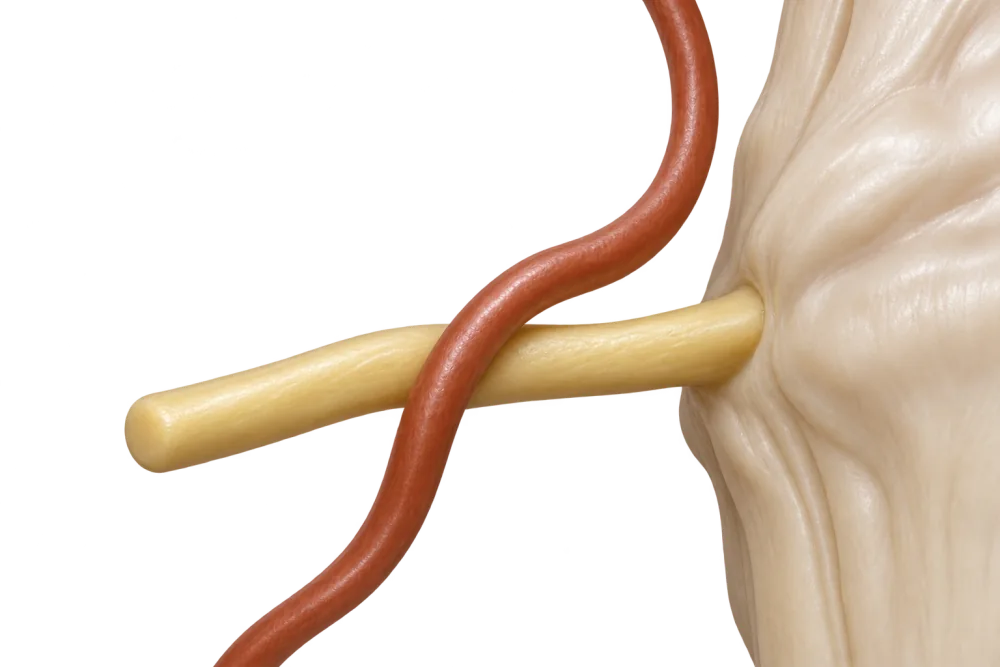
Conceptual close-up of a copper-coloured blood vessel crossing a pale gold nerve root near the brainstem
Nerve root Blood vesselConceptual nerve–vessel relationship. A vessel touching the root does not establish compression or a diagnosis.

CLASSICAL

Compression changes the nerve

A nearby blood vessel presses on the nerve near its root. In classical trigeminal neuralgia the nerve shows a change in shape, such as displacement or thinning. Contact on a scan alone does not establish the diagnosis.

04WARNING SIGNS / CHOOSE THE RIGHT HELP

Some changesneed urgent attention.

Facial pain can have different causes. Use emergency care for sudden stroke signs. Seek prompt clinical advice when the pattern changes.

Emergency help now

Call immediately for sudden facial droop, arm weakness or trouble speaking, even if the symptoms pass.

Call 112

Emergency number in India

PROMPT MEDICAL ADVICE

Tell a clinician what changed.

  • New or persistent facial numbness, or pain affecting both sides.
  • Fever, unexplained weight loss or other symptoms alongside the pain.
  • Pain making it difficult to eat or drink enough.
For a routine consultationRequest an appointment

05ASSESSMENT / HISTORY, EXAMINATION, IMAGING

Start with the story.Test with a purpose.

A useful assessment brings several clues together. It gives you a chance to explain what the pain is doing to your everyday life.

  1. 01

    Tell the attack story.

    Describe the place, side, feeling, duration and trigger. Say whether the pain stops between bursts, and what happens with eating, sleep or talking.

  2. 02

    Check for other causes.

    A clinician may examine sensation, facial movement and the mouth or jaw. A dental assessment may be needed if tooth or gum disease is possible.

  3. 03

    Discuss the role of MRI.

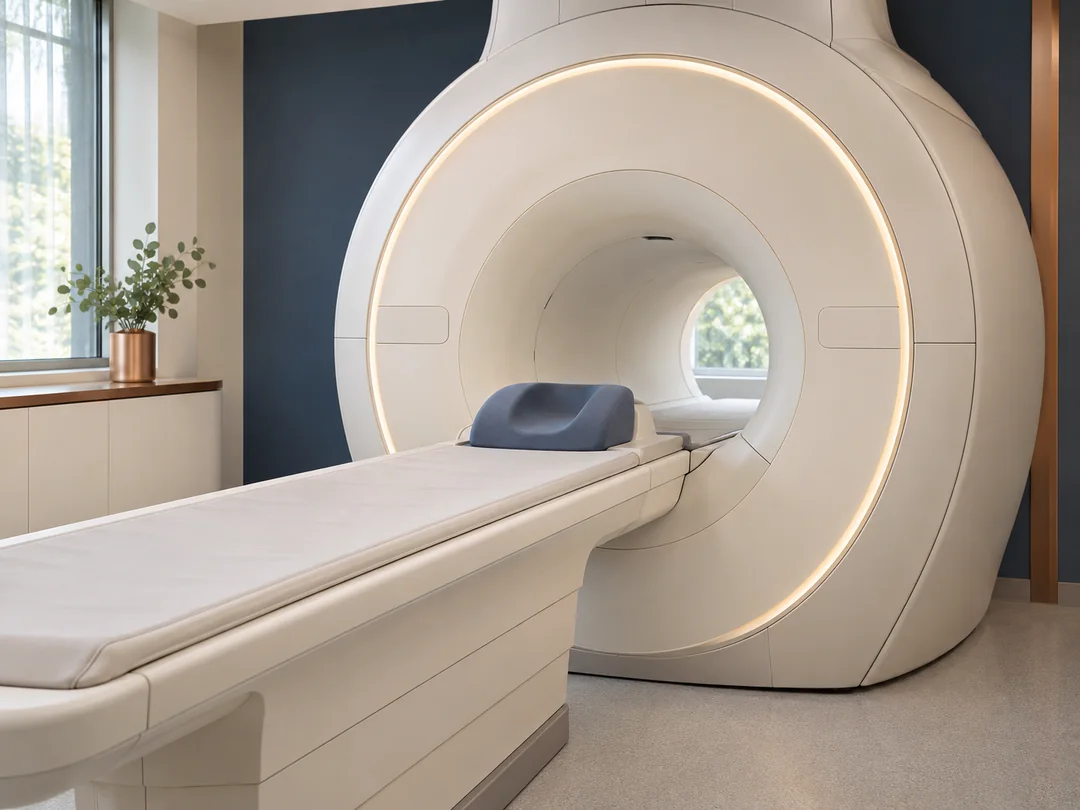
    Brain MRI can help look for other conditions and show how the nerve and nearby blood vessels relate. Your specialist interprets the images with your symptoms and examination.

Illustrative MRI scanner and empty table with a padded head cradle
Illustrative MRI suite · Discuss what imaging may help explain.

06CARE / BENEFITS AND TRADE-OFFS

Choose with your clinician.Know what success means.

The right discussion depends on the subtype, the effect on daily life, previous treatment and what trade-offs you prefer.

Compare purposes and trade-offs

Medicines

Purpose Reduce the frequency or severity of attacks.

Trade-off Side effects and interactions may limit use. Ask your prescriber what to monitor and when to contact them.

Decompression

Purpose Relieve pressure at the nerve root in selected patients.

Trade-off It is major surgery and may carry serious risks. Pain may return even after an initially helpful result.

Other procedures

Purpose Offer another option when nerve pain remains hard to control.

Trade-off Facial numbness or altered sensation can follow some procedures. Relief and recurrence vary.

MEDICINES

Review relief and side effects together.

Clinicians commonly start with a medicine such as carbamazepine. Oxcarbazepine is another first-choice option in the European guideline. The decision depends on your medical history, current medicines and monitoring needs.

Purpose
Reduce the frequency or severity of attacks.
Trade-off
Side effects and interactions may limit use. Ask your prescriber what to monitor and when to contact them.

Ask at your visitHow will we tell whether the medicine is helping enough?

Bendtsen et al. · European Academy of Neurology guideline, 2019

07EVIDENCE / SHARED DECISIONS

What does the evidence say?What can it tell you?

Start with the clinical question. Each source has a different purpose and a limit on how it applies to you.

01 / Diagnosis

A characteristic pattern carries weight.

Brief, severe, triggered pain in a trigeminal region supports assessment for trigeminal neuralgia.

What it cannot tell you

Similar symptoms need a differential diagnosis. The criteria are for clinicians to apply.

International Headache Society · ICHD-3 criteria

02 / Imaging

Look beyond simple contact.

The European guideline recommends MRI as part of the workup and considers nerve and vessel findings when planning care.

What it cannot tell you

A blood vessel touching the nerve does not by itself confirm the condition.

Bendtsen et al. · European Academy of Neurology guideline, 2019

03 / Procedures

Compare benefit and risk over time.

The Royal College guideline describes decompression and other procedural routes when medicines do not give acceptable control.

What it cannot tell you

Outcomes come from different study groups and follow-up periods. An individual estimate depends on your condition and the option under discussion.

Royal College of Surgeons of England · 2021 guideline

08VISIT PREPARATION / YOUR OWN WORDS

Record one attack.Bring one clear question.

A short note can help you remember what happened. Use these fictional examples as a starting point for describing your own symptoms.

Illustrative notebook, pen and glass on a desk
Illustrative visit preparation

FICTIONAL EXAMPLE

Tuesday · brushing my teeth

Where and how
A sharp shock across the right cheek and upper lip.
Trigger and timing
The brush touched my upper gum. Each burst lasted a few seconds and there were several.
Daily impact
I stopped brushing and ate breakfast later.
Question
Could the tooth or gum be contributing to this pattern?
What to bring

Your attack notes, medicine list and any previous dental, clinic or imaging reports you have.

09QUESTIONS / FOR YOUR NEXT CONVERSATION

Ask whatyou came here to ask.

Open an answer for the short explanation and the source behind it.

01Does pain near a tooth mean it is dental?

Pain in the upper or lower jaw can feel like it comes from a tooth. A dental examination can look for a local cause. Tell the clinician about the timing, triggers and what happens between bursts.

NHS · Trigeminal neuralgia diagnosis
02Can this cause an ache between the shocks?

Yes. A persistent background pain can occur in the same area alongside brief severe attacks. Mention the background ache as well as the shocks.

NHS · Trigeminal neuralgia symptoms
03Does a blood vessel touching the nerve prove the diagnosis?

No. A specialist looks at the attack history, examination and whether imaging shows changes to the nerve, as well as possible alternative causes.

Bendtsen et al. · European Academy of Neurology guideline, 2019
04Are procedures necessary for everyone?

No. Medicines are usually discussed first. A specialist may discuss procedures if pain remains hard to control or the medicine causes troublesome side effects.

NHS · Trigeminal neuralgia treatment
05What if the pain is affecting meals or sleep?

Tell a healthcare professional if pain is disrupting eating, drinking, sleep or your mood. That information helps them judge how quickly you need support and what to prioritise.

NHS · Trigeminal neuralgia overview

10SOURCES / EDITORIAL ACCOUNTABILITY

Know what you’re reading.Know where it comes from.

The clinic’s original article is available in full. The adapted guide also links to clinical guidance, with each source in context.

Original article

Trigeminal Neuralgia Pain · Published by IBAP Clinics

Go to the original article archive
Current guide

Adapted for IBAP Clinics with AI assistance from OpenAI Codex.

The adaptation reorganises the original article for patients and adds educational illustrations, examples and separately linked clinical guidance.

Dr Vijay Bhaskar Bandikatla

CLINIC PHYSICIAN PROFILE

Dr Vijay Bhaskar Bandikatla

Pain physician and founder, IBAP Clinics

Read the physician profile
Clinical review pending

Clinical review of the adapted text and illustrations is awaiting confirmation.

Editorial update

Guidance and evidence used in this guide

The original article includes an outdated nickname linking the condition to suicide, absolute statements about pain severity and clinic promotional claims. These reflect the historical clinic account. The adapted guidance is supported by the sources above. Individual testimonials cannot establish an expected outcome.

Read the complete original clinic article

This archive preserves the clinic’s source article, including its tables and references. It may contain earlier estimates, terminology and treatment claims. The patient guide above presents the current reading and decision-making context with separately linked guidance.

Original article destination
Bring your questions.

Discuss the pain pattern, your goals and the next step with IBAP Clinics.

Request a consultation