DISC-RELATED PAIN / A CONSIDERED APPROACH
Ozone
Nucleolysis.
A treatment directed into the spinal disc.
A decision that starts with understanding.
Explore the anatomy, the proposed mechanism and the questions that matter before choosing an intradiscal oxygen–ozone procedure.
IBAP Clinics·Banjara Hills & Madeenaguda
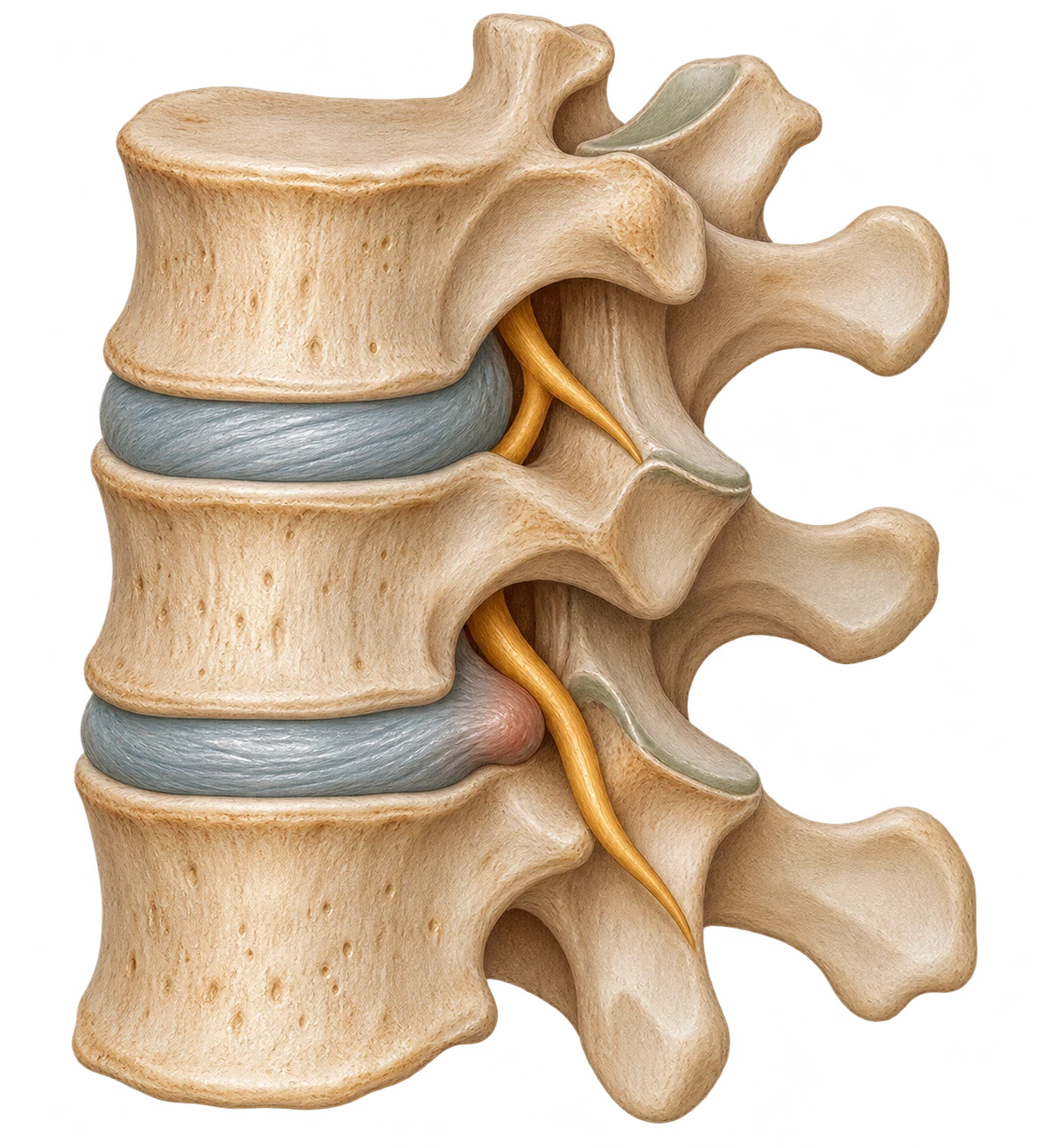
01UNDERSTANDING / THE ORIGINAL CLINIC EXPLANATION
What is Ozone
Nucleolysis?
Also called ozone disc therapy or ozone discectomy. This guide concerns treatment into the disc, rather than other routes of ozone therapy.
Ozone nucleolysis, also known as ozone disc therapy or ozone discectomy, is a minimally invasive medical procedure designed to address certain spinal conditions, particularly those related to disc issues. During the procedure, ozone gas, a reactive form of oxygen, is injected into the intervertebral disc. This treatment is often considered for conditions such as herniated discs, degenerative disc disease, and disc bulges.
This minimally invasive procedure involves the precise injection of ozone gas into the intervertebral disc. The goal of ozone nucleolysis is to alleviate pain and inflammation linked to various disc-related issues, including disc bulges. Ozone is believed to possess anti-inflammatory and analgesic properties, contributing to its potential effectiveness in providing relief for individuals experiencing spinal conditions.
A possibility to assess, not a promise. A disc change on a scan does not automatically need treatment. Your symptoms, examination and relevant imaging need to make sense together.
NHS · Slipped disc02THE ANATOMY / THE PROPOSED MECHANISM
Inside the disc.
Closer to the explanation.
Explore the structures, then the treatment proposal. A short guided sequence is available, or move through the views yourself.
Motion is off. Explore all three views at your own pace.
Layers of fibrous tissue surround the disc centre.
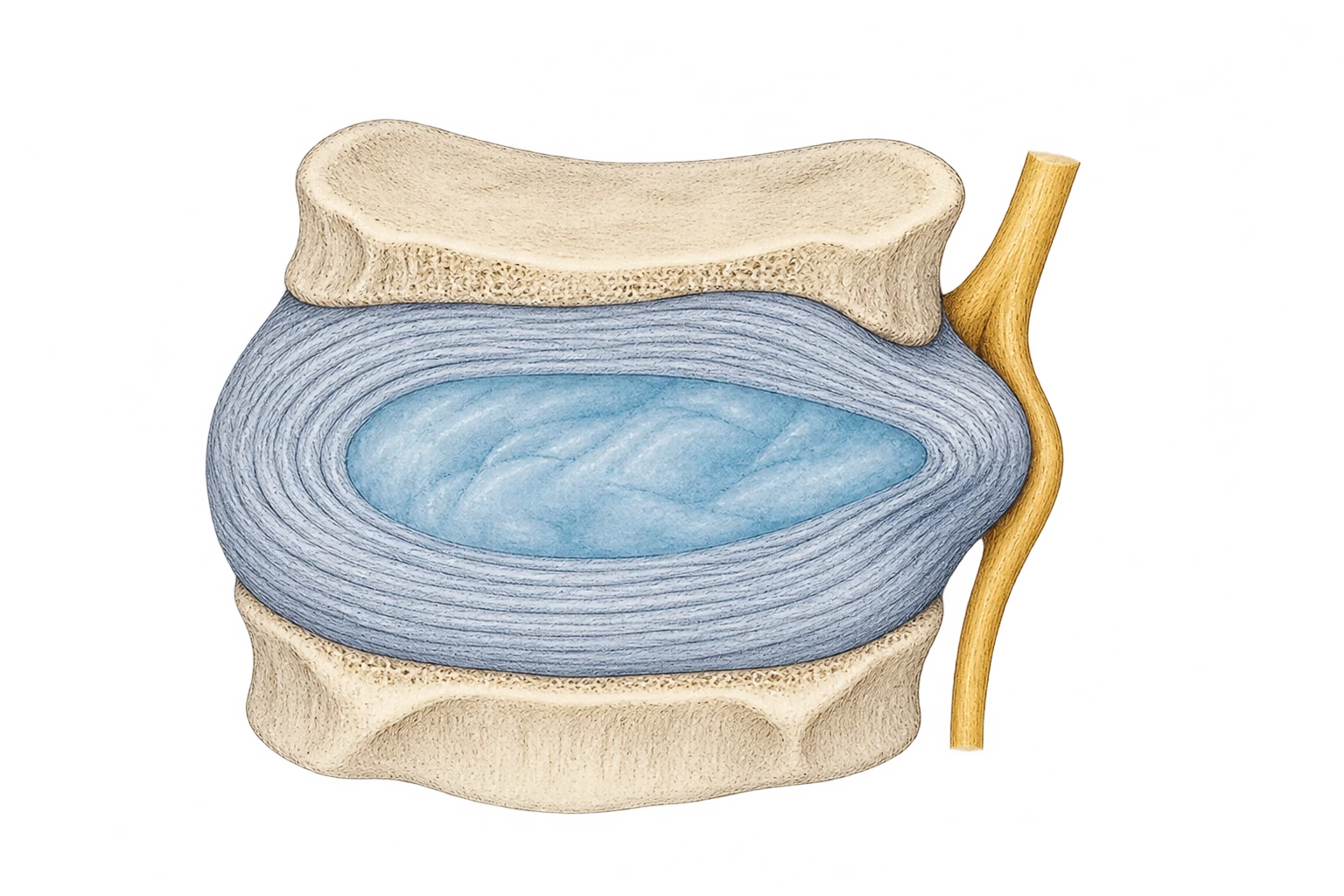
01 / Disc anatomy
A cushion. A centre. A nearby nerve.
The outer fibrous ring surrounds the softer disc centre. A bulge can come close to a nerve root, but a scan finding alone does not explain every person's pain.
NHS · Slipped discRead the complete explanation without switching views
Find the structures
The outer fibrous ring surrounds the softer disc centre. A bulge can come close to a nerve root, but a scan finding alone does not explain every person's pain.
Understand the proposal
Oxygen–ozone is proposed to alter water-binding molecules in the disc centre. This may reduce water retention and disc volume; effects on local inflammation are also proposed. These are mechanisms, not a promise that a bulge will disappear.
Review the response
Improvement is assessed through symptoms and everyday activities, alongside examination when needed. A smaller-looking disc is not, by itself, proof of a successful treatment. Persistent or worsening symptoms need reassessment.
- Outer ring · Annulus fibrosus
- Layers of fibrous tissue surround the disc centre.
- Disc centre · Nucleus pulposus
- The softer, water-containing centre is the intradiscal treatment target.
- Nearby nerve · Nerve root
- The nerve lies outside the disc. Pressure or inflammation can contribute to radiating symptoms.
FROM THE ORIGINAL ARTICLE
Disc Bulge
A disc bulge occurs when the outer layer of an intervertebral disc extends beyond its normal boundary. This can result in localized or radiating pain, and in some cases, nearby nerve compression leads to symptoms like numbness or tingling. Ozone nucleolysis is considered a potential treatment for disc bulges, aiming to reduce pain and inflammation associated with this condition.
Not every bulge causes symptoms. Local pain, radiating pain and numbness have other possible causes and require individual assessment.
NHS · Slipped disc04THE EVIDENCE / SHARED DECISIONS
Read the evidence.
Leave room for uncertainty.
The studies below concern selected lumbar disc problems. They do not establish the same benefit for every disc bulge, neck condition or ozone injection route.
AN INFORMED DECISION HAS TWO PARTS
What has been studied.
What matters to you.
Ask about the likely benefit for your diagnosis, the chance of no improvement, complications and the plan if symptoms persist. Agree on a goal you can recognise in everyday life.
“What would meaningful improvement look like for me?”A question to bring to your consultation
2022 / RANDOMISED PILOT TRIAL
A selected group.
A limited comparison.Forty-nine patients with a single-level contained lumbar disc herniation were randomised to oxygen–ozone or microdiscectomy. The pilot reported non-inferiority for its six-month leg-pain outcome.
Keep in mindA small pilot in selected patients does not establish equivalence for every disc problem or reveal every uncommon complication.
Kelekis et al. · 2022 randomised pilot trial2026 / RANDOMISED COMPARISON
Both groups improved.
The results differed.A 90-patient trial compared intradiscal ozone with nucleoplasty. Both groups improved; nucleoplasty had better outcomes at 12 months. The authors noted the limited sample and follow-up.
Keep in mindNucleoplasty is a different procedure. This comparison does not show that either treatment is right for everyone.
Kilic & Sahin · 2026 randomised trialSAFETY / CASE REPORT
Minimally invasive
still needs careful consent.A published cervical case report describes a serious disc and spinal infection after oxygen–ozone treatment. The neck location differs from lumbar treatment, but the report shows why serious risks need discussion.
Keep in mindA case report identifies a possible complication. It cannot tell us how often that complication occurs.
Andrés-Cano et al. · 2016 complication report
- Intradiscal
- Within an intervertebral disc.
- Non-inferiority trial
- Tests whether a treatment is not worse than its comparator by more than a pre-set margin, for a particular outcome.
- Meaningful improvement
- A change in pain or daily function that matters to you, rather than a scan change alone.
05CARE & RECOVERY / AN INDIVIDUAL PLAN
A procedure is one part.
The care plan matters.
Additional practical guidance. Your treating team's written preparation and discharge instructions take priority.

BRING YOUR QUESTIONS / LEAVE WITH A PLAN
Before the appointment.
- Bring relevant reports, scans and a current medicine list.
- Tell the team about allergies, infection symptoms, pregnancy possibility and medical conditions.
- Ask for specific medicine and fasting advice; do not stop medicines yourself.
- Clarify transport, any sedation, costs and who to contact after discharge.
- 01
Assess & agree
Review the diagnosis, evidence, alternatives and personal risks before giving consent.
- 02
Image-guided care
Ask how imaging, sterile technique and observation are used in your planned procedure.
- 03
Recover at your pace
Follow individual instructions for activity, driving and medicines. Ask before returning to demanding work or exercise.
- 04
Review & reassess
Agree on follow-up, progress toward your goals and the next step if pain persists.
RISKS / DISCUSS BEFORE CONSENT
Ask about your individual risks.
Discuss infection, bleeding, nerve or tissue injury, medicine or sedation reactions and the possibility of no improvement or worsening pain. Ask which risks apply to the route and spinal level planned for you.
Andrés-Cano et al. · 2016 complication reportAFTERCARE / KNOW WHO TO CALL
Leave with written advice.
Confirm what symptoms to expect, how to care for the injection site and how to reach your team. Fever, feeling unwell or severe or worsening pain after an injection needs prompt medical advice.
Clinic contactYOUR QUESTIONS / CLEAR ANSWERS
A little more clarity.
Before you decide.
Additional patient questions, with sources linked to each answer.
Ask about your situationTHE PROCEDURE
Ozone nucleolysis refers specifically to treatment directed into an intervertebral disc. Other ozone treatments use different sites or routes. Evidence from one route or condition cannot automatically be applied to another.
Original IBAP Ozone Nucleolysis articleNo. Many disc changes cause no symptoms, and many symptomatic disc problems improve with non-procedural care. Your symptoms, examination and relevant imaging should be considered together before choosing a treatment.
NHS · Slipped discEXPECTATIONS & ALTERNATIVES
It is not a mechanical repositioning procedure. The proposed action involves chemical changes within the disc, with possible effects on volume and inflammation. Relief and structural change are not guaranteed.
Hosseini et al. · 2019 clinical studyNo. Research concerns selected patients and does not establish that ozone is suitable for every herniation or equivalent to surgery in every setting. Worsening weakness and bladder or bowel symptoms need urgent assessment rather than a routine procedure enquiry.
Kelekis et al. · 2022 randomised pilot trialRECOVERY & DECISIONS
Ask for written instructions tailored to the procedure, any sedation and your work or activity demands. Follow your treating team's advice on medicines, driving and returning to exercise; there is no single timetable that suits everyone.
Hosseini et al. · 2019 clinical studyAsk why this treatment fits your diagnosis, what evidence applies to your type of disc problem, what risks and alternatives matter, the full cost and how follow-up will be arranged. Agree on what would count as meaningful improvement for you.
Kilic & Sahin · 2026 randomised trialYOUR NEXT STEP / A CONVERSATION FIRST
Understand your options.
Choose with confidence.
Bring your symptoms, reports and questions. Together with your care team, explore the option that fits your diagnosis and priorities.
SOURCE / CONTEXT / TRANSPARENCY
About this guide.
The complete clinical wording from the original IBAP article is retained in “What is Ozone Nucleolysis?” and “Disc Bulge”. The interactive explanation, evidence summaries, care prompts and FAQs are additional patient guidance with linked sources.
Original IBAP Ozone Nucleolysis articleMeet Dr Vijay Bhaskar BandikatlaSources & further reading
Illustrations & clinical review
The anatomical artwork and consultation photograph are generated educational illustrations. They are not real scans, actual procedure footage, identified clinicians or evidence of a patient's outcome.
General education, not an individual diagnosis or recommendation. Ozone nucleolysis is an invasive medical procedure requiring specialist assessment and informed consent. Benefits and risks vary; the original article's potential benefits are not guaranteed outcomes.