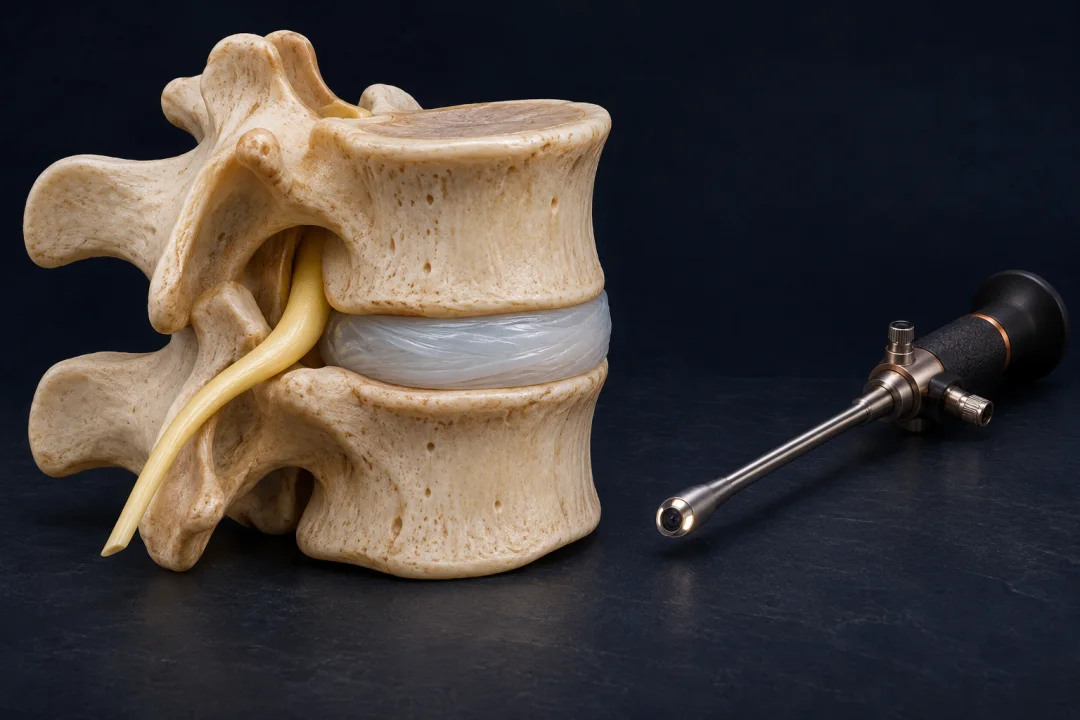
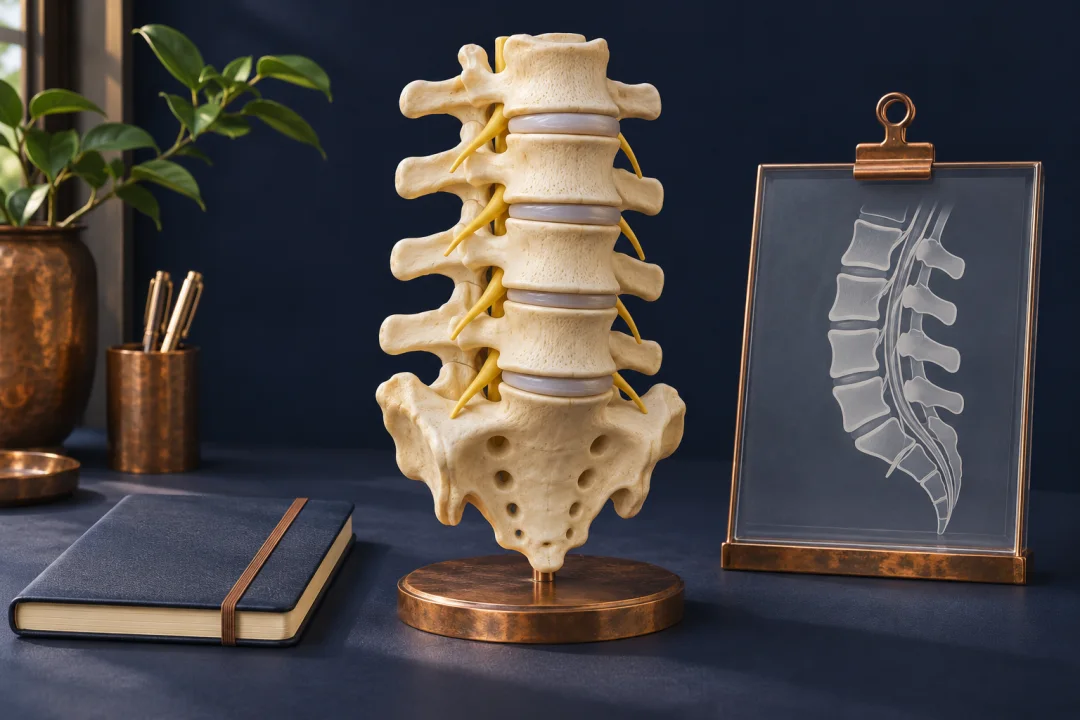
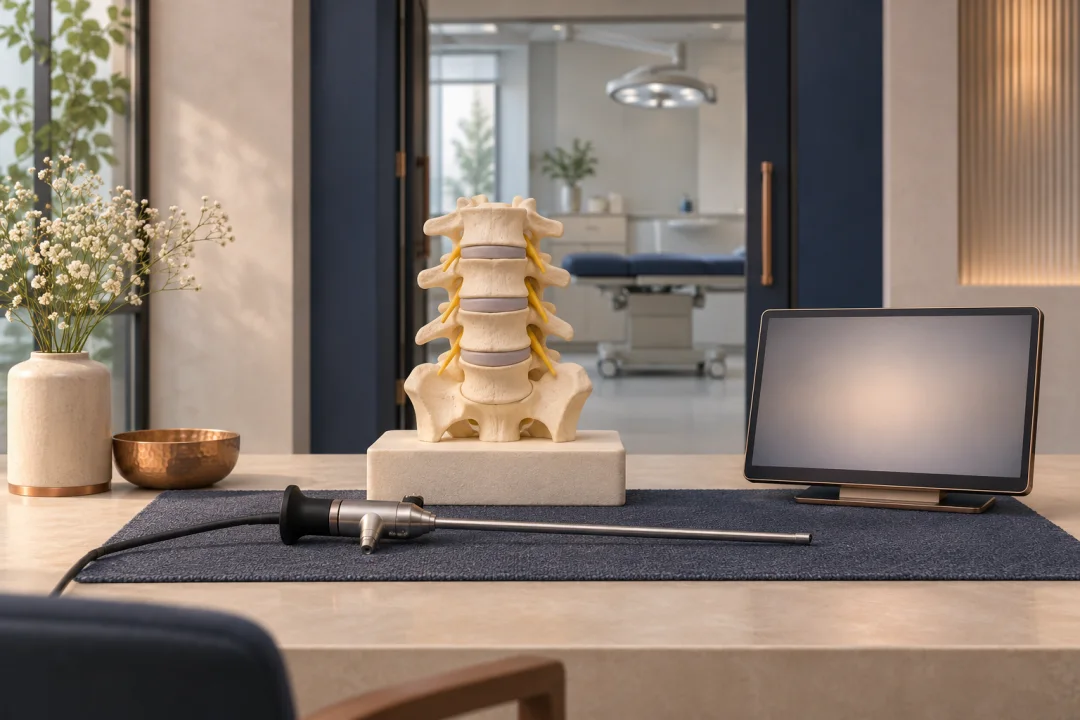
Lumbar spine and endoscope · educational illustration
Confirm the causeAsk how your examination and scan fit your symptoms.
Compare care optionsAsk which operation is proposed and what alternatives apply.
Choose a measurePick a daily activity you want to do more comfortably.
Contents 01 / 09Spine anatomy
01Anatomy / three views
Where the nerve runs. What the camera shows.
Explore a lumbar disc, a nearby nerve root and the instrument used to see the area.
Loading illustration…
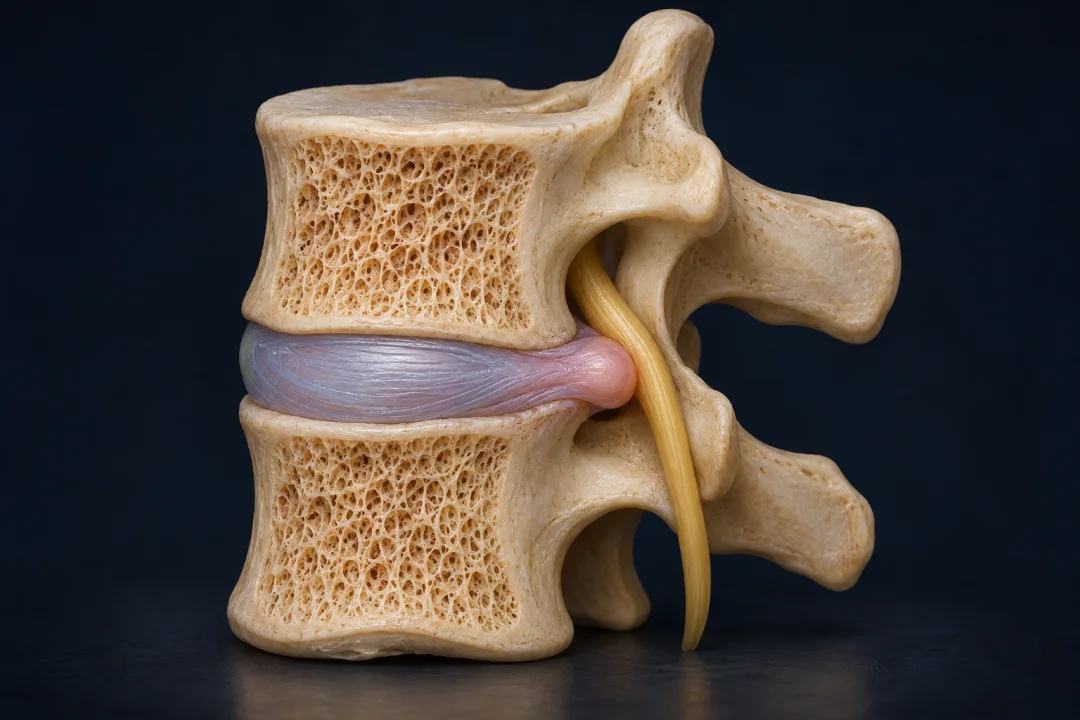
01 / The disc
Where a disc can bulge
Discs cushion the bones of the spine. A herniation is disc material that pushes out and can irritate a nearby nerve.
Loading illustration…
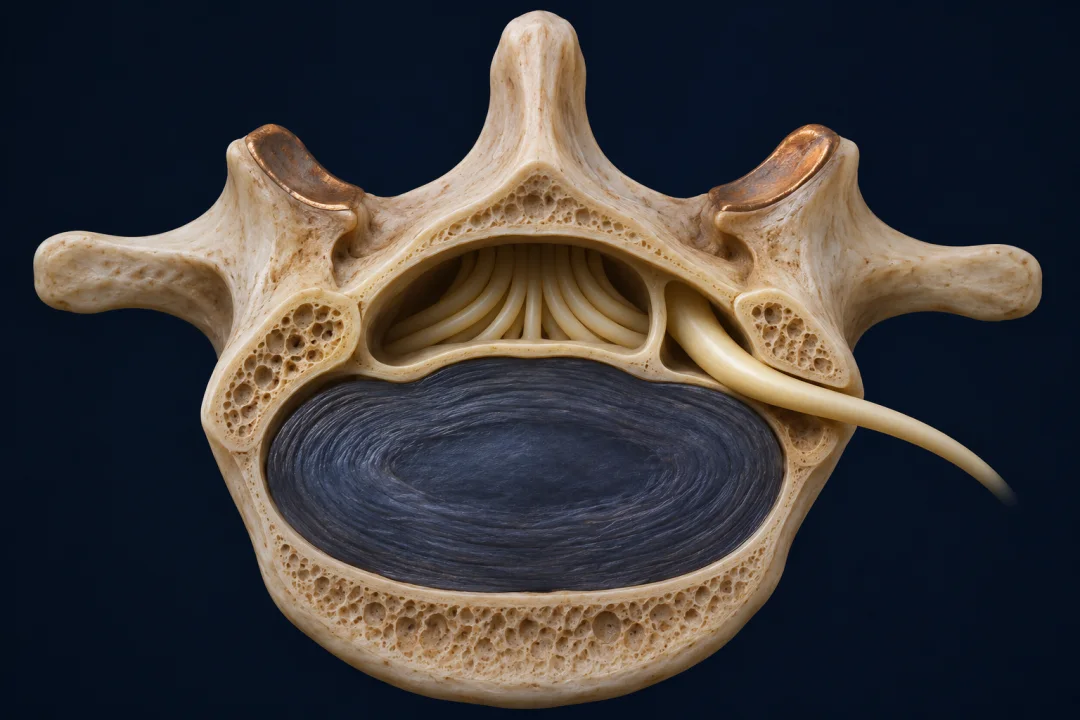
02 / The nerve
Why symptoms can travel
A nerve root in the lower back helps carry signals to the leg. Pressure or irritation can cause pain, altered sensation or weakness.
Loading illustration…
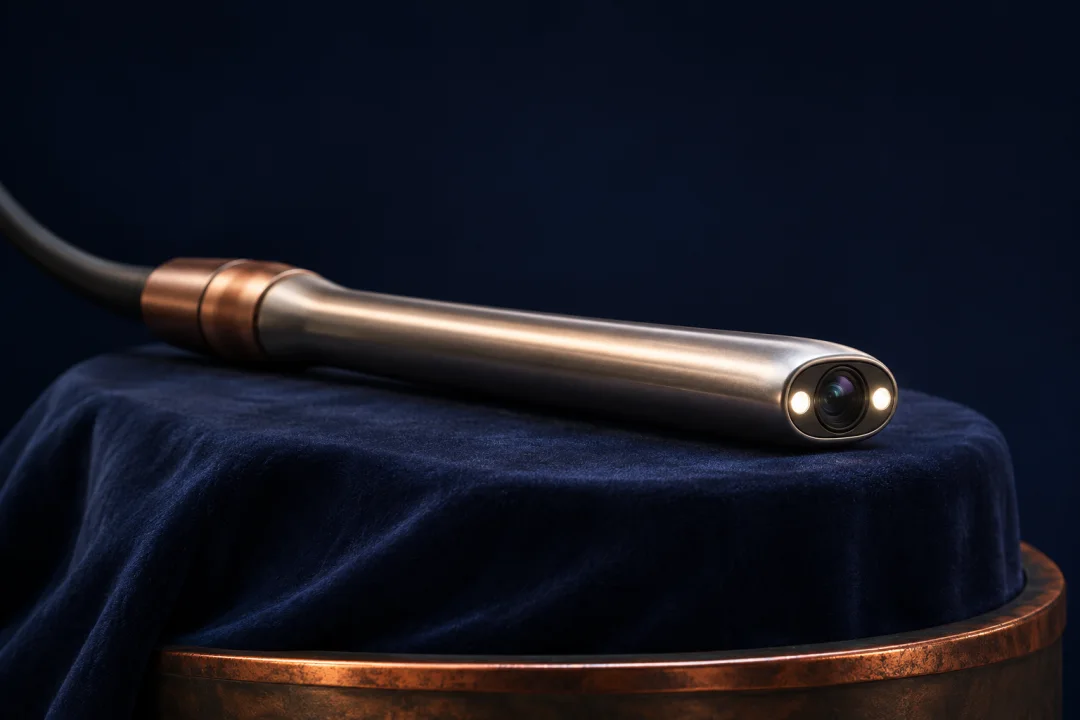
03 / The camera
What the camera shows
This tiny camera gives the surgeon a close view. In a discectomy, the surgeon removes disc material that is pressing on a nerve.
02Assessment / symptoms and goals
Start with your symptoms. Match the findings.
Ask how the symptoms, examination and imaging fit together.
01
Describe the symptom pattern
Tell the clinician where pain travels and whether you have numbness or weakness. Describe how long it has lasted and which activities it limits.
02
Match the findings
The clinician compares your history, strength, sensation and other examination findings with imaging if it will inform the decision. A scan finding alone cannot identify the source of symptoms.
03
Choose a goal for discussion
Pick a concrete aim, such as walking to the shops. Ask which symptoms a procedure might improve, what may remain and when you would review progress.
The options depend on where the nerve is affected, the severity and duration of symptoms and what care you have tried.
Discuss an active care plan
Consider what has helped so far. Depending on your symptoms, discuss staying active, tailored exercise or physiotherapy, and a review of medicines. In selected cases of acute, severe sciatica, a clinician may consider an epidural injection.
Ask who will perform the procedure, which surgical approach they propose and where you will be cared for after surgery.
Ask the surgical team how the plan applies to your situation.
Before
Review the decision
Ask how the examination and scan support the recommended operation. Review alternatives, your health, your medicines and the anaesthesia plan with the surgical team.
On the day
Confirm what the team will do
For endoscopic discectomy, the surgeon uses a small camera to see the area while removing the disc material that presses on the nerve. The details depend on the operation.
Before leaving
Make a written plan
Ask how to manage discomfort and care for the wound, when to resume activity, and who to contact after hours. Confirm your follow-up arrangements.
Get emergency care for new leg weakness after surgery, numbness around the genitals or anus, or new trouble passing urine or controlling your bladder or bowels. Call 112 in India if you need emergency help.
Contact your team promptly for fever, growing redness or swelling, or fluid leaking from the wound. Ask for urgent assessment if pain is worsening or you cannot reach your team.
Possible complications include bleeding, infection, nerve injury or a spinal fluid leak. Symptoms can persist or return, and some people need further surgery. Ask how the risks depend on your health and proposed procedure.
Recovery depends on the procedure, your general health and the activities you want to resume.
Discuss a walking and activity plan with the surgical team.
01
Plan for activity
Ask when and how to start walking and build activity safely. Ask specifically about driving, work, lifting and travel.
02
Follow the discharge plan
Use the wound and medicine instructions from your surgical team. Ask who to call about symptoms and when physiotherapy may help.
03
Track a goal over time
Record changes in a daily activity, leg symptoms and any new problems to discuss at follow-up. Healing and symptom improvement can follow different timelines.
Two decisions, two comparisons. Look at what was measured.
At a glance · Disc-related sciatica
Technique
One endoscopic approach performed similarly to open microdiscectomy for leg pain at one year.
Timing
Early disc surgery eased symptoms faster in a separate trial. Results were similar by one year.
These studies answer different questions. Ask which comparison applies to your diagnosis and the operation proposed.
Compare the patients studied, the operations and the outcome measured.
BMJ · 2022 randomised trial
One endoscopic technique compared with open surgery
In a Dutch trial of selected adults with sciatica from a lumbar disc herniation, transforaminal endoscopic discectomy met the trial’s prespecified threshold for how closely leg pain outcomes matched open microdiscectomy at 12 months.
Discuss the evidence
The difference in leg pain scores favouring the endoscopic group was small and might not matter to patients. This result addresses one technique in one trial population. It gives limited information about other operations or diagnoses.
Early lumbar disc surgery relieved sciatica faster than continued nonsurgical care in this study. Results were similar by one year and remained similar at two years.
Discuss the evidence
The continued care strategy allowed later surgery if needed. This trial compared timing strategies for selected people with disc-related sciatica and did not compare endoscopic techniques.
NICE advises considering decompression when nonsurgical treatment has not improved pain or function and imaging findings fit the sciatic symptoms.
Discuss the evidence
That recommendation informs assessment for decompression rather than selecting a particular operating technique. Urgent neurological changes need prompt assessment.
NICE publishes separate guidance for transforaminal and interlaminar endoscopic lumbar discectomy. The guidance discusses consent, audit and procedure-specific training.
Discuss the evidence
The names describe different routes for reaching the disc in lumbar surgery. Discuss whether either applies to your diagnosis and how the team monitors outcomes.
2022 Dutch randomised trial of transforaminal endoscopic discectomy versus open microdiscectomy in selected adults with sciatica from a lumbar disc herniation.