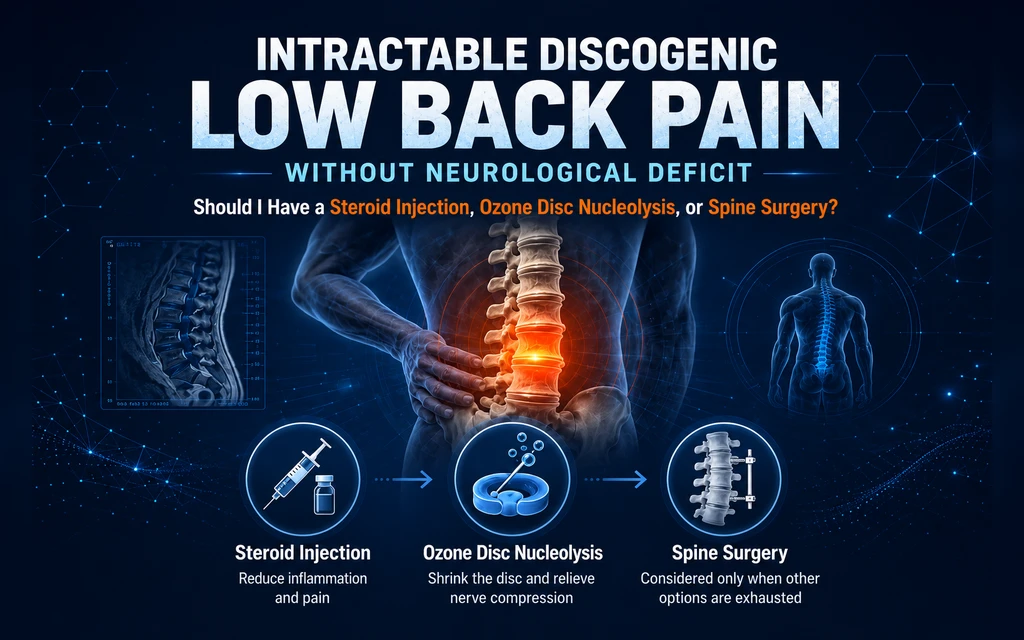
If you are sitting with chronic back pain that has not responded to physiotherapy, rest, or painkillers — and your doctor has mentioned either injections, an ozone procedure, or surgery — you are likely feeling overwhelmed. Three very different options. Three very different risk profiles. And often, not enough time in the consultation to fully understand which is right for you and in what order.
I see this pattern every week in clinic. Patients arrive having been handed a surgical referral — sometimes after just one or two steroid injections — without anyone explaining that there is a structured, evidence-based pathway between "basic injections" and "going under the knife." That pathway includes ozone disc nucleolysis, a minimally invasive, day-case procedure that, in the right patient, can eliminate the need for surgery entirely.
This guide compares all three options honestly — their mechanisms, their success rates, their risks, and critically, the order in which they should be considered when you have intractable back or leg pain but no neurological deficit (no foot drop, no motor weakness, no bladder or bowel symptoms).
In patients with severe back or leg pain but no neurological deficit, national and international guidelines recommend exhausting minimally invasive interventional options — including procedures such as ozone disc nucleolysis — before considering spinal surgery. Surgery in pain-only patients carries a 20–46% long-term failure rate.
The intervertebral disc — the shock-absorbing cushion between your vertebrae — has a tough outer ring (annulus fibrosus) and a soft gel-like centre (nucleus pulposus). When the disc herniates or degenerates, the gel bulges outward and presses on a nearby nerve root. The result: back pain, leg pain (sciatica), burning, numbness, or all of the above.
The disc's problem is not just mechanical compression. The herniated material is chemically irritating — it releases inflammatory substances (phospholipase A2, substance P, cytokines) that drive nerve inflammation independently of any physical pressure. This is why patients can have significant pain even from a relatively small herniation, and why some people with large herniations feel little pain at all.
Three interventions address this problem — but at three very different levels:
Think of your disc as a water pipe that has sprung a leak under the floorboards. An epidural steroid injection is like mopping up the water — it reduces the immediate damage and inflammation, but the pipe is still leaking. Ozone disc nucleolysis is the plumber who goes in and repairs the pipe itself — shrinking the disc from within and stopping the leak at source. Spinal surgery is ripping out the entire pipe section and replacing it — effective when necessary, but a permanent structural change you cannot undo. For a leak without a structural emergency, you repair the pipe before you replace it.
Option A: Epidural steroid injection (ESI / TFESI)
A corticosteroid (usually methylprednisolone or dexamethasone) is delivered via needle into the epidural space — the narrow canal surrounding the spinal cord and nerve roots. It does not touch the disc itself. What it does is reduce the inflammatory swelling around the compressed nerve, providing pain relief and improved function during the healing phase. When performed as a transforaminal injection (TFESI), the steroid is delivered precisely to the affected nerve root level under fluoroscopy (live X-ray) guidance.
Steroid injections are excellent at what they do: they calm the fire quickly, allow physiotherapy to progress, and in early, acute radiculopathy, sometimes buy enough time for the disc to resolve naturally. The problem arises when they are used repeatedly as a long-term strategy — which they were never designed for.
Option B: Ozone disc nucleolysis (intradiscal O₂–O₃ injection)
Ozone disc nucleolysis works at the source — inside the disc itself. A precisely calibrated mixture of oxygen and ozone (O₂–O₃) gas, at a concentration of 27–30 micrograms per millilitre, is injected directly into the disc nucleus under fluoroscopy guidance. Ozone is a powerful oxidising agent: it breaks down the proteoglycan molecules that give the nucleus its water-retaining, gel-like structure. The disc nucleus dehydrates, shrinks, and retracts — physically reducing the bulge that is compressing the nerve root.
Simultaneously, a periradicular injection of ozone with a small amount of local anaesthetic is delivered around the affected nerve root, addressing the inflammatory component. The entire procedure takes 30–45 minutes; patients are discharged home the same day. There are no incisions, no implants, and no general anaesthesia. Ozone reverts to ordinary oxygen within approximately 45 minutes — leaving no foreign substance in the body.
Option C: Spinal surgery (microdiscectomy or lumbar fusion)
Surgery physically removes the offending disc material (discectomy) or stabilises an unstable spinal segment (fusion). When neurological deficit is present — foot drop, progressive leg weakness, or cauda equina syndrome — surgery is urgent and unambiguous. For pain-only patients, however, the evidence is considerably less compelling, and the risk of long-term surgical failure is frequently underappreciated.
Patient profile: intractable discogenic/radicular pain, failed conservative management (≥6 weeks physiotherapy + analgesics), no motor deficit, no cauda equina syndrome.
| Parameter | Epidural steroid injection (ESI / TFESI) | Ozone disc nucleolysis (intradiscal O₂–O₃) | Spinal surgery (discectomy / fusion) |
|---|---|---|---|
| Mechanism | |||
| How it works | Steroid reduces nerve-root inflammation in the epidural space. Does not alter disc morphology. | Ozone oxidises nucleus pulposus proteoglycans → disc shrinks → nerve decompressed. Also anti-inflammatory via cytokine suppression. | Physically removes disc material (discectomy) or immobilises unstable segment (fusion). |
| Efficacy | |||
| Short-term pain relief | Moderate NRS drops 2–3 points; leg pain responds better than back pain. |
Good–Excellent Significant ODI and NRS improvement at 2 and 6 months in prospective cohorts. |
Excellent (leg pain) 80%+ good/excellent results for radiculopathy at 3 months in microdiscectomy series. |
| Long-term durability | Limited 25–72% proceed to surgery within 2 years. Benefits wane; repeated injections show diminishing returns. |
Durable Only 18% required surgery at 5 years; no new surgeries documented at 10 years (Magalhaes et al.). MRI confirms disc volume reduction. |
Variable ~62% overall LBP improvement post-decompression. Recurrent herniation in 5–25% within 5 years. |
| Surgery avoidance | Poor Majority of steroid-only patients ultimately proceed to surgery. |
Strong — 82% surgery-free at 5 years. | N/A. FBSS rate: 19–25% (discectomy), 30–46% (fusion). |
| Safety | |||
| Key risks |
|
|
|
| Steroid burden | Significant — cumulative risk to bone density, blood glucose, adrenal axis. | None — completely steroid-free. Ideal for diabetics, osteoporotic patients. | Minimal — peri-operative only. |
| Practicalities | |||
| Setting & recovery | Day case. Fluoroscopy/ultrasound-guided. Back to activity in 24–48 hrs. | Day case. Fluoroscopy-guided (DSA suite). Home same day. Mild soreness 24–72 hrs. | Hospital 1–5 days. General/spinal anaesthesia. Full recovery 6–12 weeks; work return 3–6 months. |
| Reversibility | Fully reversible. No structural change. | Disc-volume change is permanent, but no implants or anatomical disruption. | Irreversible. Altered spinal biomechanics are permanent. Fusion eliminates motion segment. |
| Repeatability | Typically 3× per year per level maximum. Cumulative steroid risk limits frequency. | Can be repeated (2nd session at 4–6 weeks if partial response). No cumulative toxicity. | Re-operation risk rises sharply: instability increases from 12% (1st reoperation) to 50% (4th). |
| Cost (India) | Low. Widely available. | Moderate. Requires fluoroscopy suite and specialist training. Available at IBAP Clinics, Hyderabad. | Highest. Inpatient stay, implants (fusion), rehabilitation, lost income during recovery. |
| Evidence & guidelines | |||
| Evidence level | Level I–II (multiple RCTs). Supported for short-term radiculopathy; weaker for axial pain. | Level II–III (prospective cohorts + one non-inferiority RCT vs microdiscectomy; 2024 systematic review & meta-analysis). | Level I for neurological deficit. Level II–III for pain-only indication — evidence is weaker than commonly assumed. |
| IBAP pathway position | |||
| Recommended role | Step 2 — First interventional option Diagnostic + therapeutic. If 1–2 ESIs fail to give sustained relief (>3 months), escalate. |
Step 3 — Preferred non-surgical intervention Addresses the disc structurally. 82% surgery-free at 5 years. Performed at IBAP Clinics under fluoroscopy. |
Step 4 — Last resort (pain-only patient) Reserve for failure of full interventional pathway OR new neurological deficit. |
| If surgery fails — Failed Back Surgery Syndrome (FBSS) | |||
| What happens when surgery doesn't work? | ESI alone in FBSS shows only ~12% success rate in clinical trials — insufficient as a standalone strategy once fibrosis is established. | Ozone can be used adjunctively in FBSS cases without significant fibrosis, but epidural adhesiolysis is the primary intervention once scar tissue is confirmed. | FBSS affects 20–46% Persistent or new pain after surgery due to epidural fibrosis, nerve-root tethering, instability, or recurrent herniation. Repeat surgery carries even higher failure rates. |
| FBSS rescue — epidural adhesiolysis (Racz neuroplasty / epidurolysis) |
When surgery fails, IBAP Clinics offers epidural adhesiolysis (epidurolysis) — the specialist minimally invasive rescue procedure for FBSS.
What it is: A spring-guided steerable Racz catheter is introduced into the epidural space under fluoroscopy, navigated to the site of fibrosis, and used to mechanically disrupt scar tissue while delivering hyaluronidase, local anaesthetic, and corticosteroid directly to the adhesion.
What it treats: Epidural fibrosis (post-surgical scar tissue), tethered nerve roots, spinal stenosis with adhesions, recurrent disc herniation with epidural scarring.
Evidence: 73% of FBSS patients achieve significant pain relief with adhesiolysis vs 12% with epidural injection alone (Manchikanti et al. RCT). 2023–2025 prospective data and systematic reviews confirm durable benefit at 6–12 months.
At IBAP Clinics: Performed as a day case under fluoroscopy guidance. Epiduroscopy (direct visual guidance via fibre-optic camera) also available for complex cases. Call 9807 55 6789.
|
||
Physiotherapy + analgesics
Structured physiotherapy, NSAIDs, neuropathic pain agents. Minimum 6 weeks. If failing → proceed to interventional.
Epidural steroid injection (TFESI)
Fluoroscopy-guided, targeted to the affected nerve root. Diagnostic and therapeutic. Maximum 1–2 injections before reassessment.
Ozone disc nucleolysis
Day-case, fluoroscopy-guided intradiscal procedure. Repairs the disc at source. 82% surgery-free at 5 years. Available at IBAP Clinics.
Spinal surgery
Only after failure of full interventional pathway — or if new neurological deficit (motor weakness, cauda equina) develops. Get a specialist opinion first.
Epidural adhesiolysis / epidurolysis
When surgery leaves scar tissue (epidural fibrosis) trapping nerve roots, the Racz neuroplasty procedure mechanically dissolves those adhesions. 73% pain relief success in FBSS patients. Day case at IBAP Clinics.
Patients who exhaust the interventional pathway before surgery have better surgical outcomes than those rushed to theatre early. Conversely, surgery in pain-only patients before trying ozone nucleolysis is — in most cases — premature. The decision carries permanent consequences; the preparation must be thorough.
Everything discussed above applies to patients with pain as their dominant — and only — symptom. Surgery becomes urgent and appropriate when any of the following are present:
- Cauda equina syndrome — loss of bladder or bowel control, saddle anaesthesia. This is a surgical emergency.
- Progressive motor weakness — foot drop, worsening leg weakness despite treatment.
- Rapidly escalating neurological deficit — numbness or weakness spreading or worsening week on week.
- Large sequestrated disc fragment with significant cord or cauda equina compression on MRI.
Similarly, ozone disc nucleolysis is not appropriate for: severely collapsed discs (Pfirrmann grade V, >2/3 height loss), active spinal infection, uncontrolled hyperthyroidism, or large migrated/sequestrated fragments. A thorough MRI review and clinical assessment by a specialist is mandatory before any procedure.

Physiotherapy + analgesics
Structured physiotherapy, NSAIDs, neuropathic pain agents. Minimum 6 weeks. If failing → proceed to interventional.
Epidural steroid injection (ESI / TFESI)
Fluoroscopy-guided, targeted to the affected nerve root. Diagnostic and therapeutic. Maximum 1–2 injections before reassessment.
Ozone disc nucleolysis
Day-case, fluoroscopy-guided intradiscal procedure at IBAP Clinics. Shrinks the disc at source. 82% surgery-free at 5 years.
Spinal surgery
Only after full interventional failure — or new neurological deficit. Fails in 20–46% of cases, causing Failed Back Surgery Syndrome (FBSS).
⬇ Step 5 — If surgery fails: FBSS — two options
Each reoperation generates more epidural fibrosis and carries higher complication risk. Spinal instability escalates from 12% after the 1st reoperation to 50% after the 4th. Diminishing returns with each revision.
Day-case fluoroscopy-guided procedure. A steerable Racz catheter dissolves post-surgical epidural scar tissue and delivers hyaluronidase + local anaesthetic + corticosteroid directly to trapped nerve roots. 73% success in FBSS vs 12% with injections alone. Epiduroscopy available for complex fibrosis. Available at IBAP Clinics Banjara Hills & Madeenaguda — ☎ 9807 55 6789.
| Study / Source | Intervention | Key Finding |
|---|---|---|
| Magalhaes et al. Int J Spine Surg (2014) — PMC4325503 | Intradiscal ozone (n=108, 10-yr follow-up) | Only 18% required surgery at 5 years; no new surgeries at 10 years. MRI confirmed consistent disc volume reduction. |
| Gallucci et al. PMC6208962 | Ozone nucleolysis vs conservative | Significant ODI and pain-scale improvement at 2 and 6 months; 70–80% therapeutic success rate; lowest cost and complication profile among percutaneous techniques. |
| Spine Journal RCT (2021) — S1529-9430 | Ozone vs microdiscectomy (randomised) | Ozone was non-inferior to microdiscectomy for radiculopathy in appropriately selected patients (contained herniations, ≥50% disc height). |
| Chang et al. SAGE BMR-240024 (2024) — systematic review | Intradiscal ozone, meta-analysis | Pooled data confirm statistically significant pain reduction and functional improvement; favourable safety profile across all included studies. |
| StatPearls — FBSS (2023) NBK539777 | Lumbar surgery outcomes | FBSS failure rates: 19–25% for microdiscectomy, 30–46% for lumbar fusion. Underlines the importance of exhausting non-surgical options first. |
| Dohrmann & Mansour Med Princ Pract (2015) — analysis of 39,000 patients | Lumbar discectomy long-term | Good to excellent results in 80%+ at short-term follow-up, but overall LBP improvement post-decompression approximately 62% at longer follow-up. |
| Multiple ESI series (cited in Magalhaes 2014) | Epidural steroid injections | 25–72% of patients receiving ESI for disc herniation proceed to surgery within 2 years — underlining the limitation of ESI as a standalone long-term strategy. |
Here is the part of the surgical conversation that rarely happens in the pre-operative consultation. When back surgery fails — and it does in 20–46% of cases — the result is a condition called Failed Back Surgery Syndrome (FBSS). The International Association for the Study of Pain defines it as persistent lumbar or radicular pain following spinal surgery in the same topographical location — pain that is either unchanged, worsened, or entirely new.
The dominant mechanism behind FBSS is epidural fibrosis — dense scar tissue that forms in the epidural space after surgery. Think of it this way: surgery is a controlled injury to the spine. As the body heals, it lays down collagen fibres to repair the disrupted tissue. In some patients, this scarring becomes excessive, wrapping around the nerve roots like cling-film around a live wire — compressing them, restricting their blood supply, and generating constant pain signals that have nothing to do with any remaining disc problem. The surgical target may have been perfectly addressed; it is the aftermath that creates the new pain.
Repeat surgery for FBSS is not the answer. Each subsequent operation carries higher complication rates, more fibrosis, and lower success — spinal instability rises from 12% after the first reoperation to 50% after the fourth. What FBSS patients need is a specialist minimally invasive procedure that goes directly to the scar tissue — and that procedure is epidural adhesiolysis.
Epidural adhesiolysis (Racz neuroplasty / epidurolysis) — the IBAP Clinics approach
Epidural adhesiolysis was developed by Dr Gabor Racz in the late 1980s and remains the most evidence-supported minimally invasive intervention for FBSS. At IBAP Clinics, the procedure is performed as a day case under fluoroscopy guidance. Here is what happens:
Imagine your post-surgical nerve root as water trying to flow through a drain that has been blocked by accumulated scar debris. The Racz catheter is the specialist drain-clearing tool — guided precisely to the blockage, it physically disrupts the fibrous material and then flushes the area with a solution (hyaluronidase) specifically designed to dissolve the adhesive proteins holding the scar together. The nerve root, freed from its fibrous wrapping, can restore normal blood flow and begin functioning without the constant pain signal.
The catheter — a flexible, spring-guided instrument — is introduced through the caudal epidural space and navigated under live fluoroscopy to the exact level and side of the confirmed fibrosis. A contrast epidurogram first maps the adhesion by showing where the contrast dye fails to flow freely — the "filling defect" that identifies the scar. The catheter is then steered to that point. The procedure delivers:
- Hyaluronidase — an enzyme that specifically dissolves the hyaluronic acid bonds in fibrous adhesions, breaking down the scar tissue matrix
- Hypertonic saline — reduces oedema around the compressed nerve root and provides a prolonged analgesic effect
- Local anaesthetic — immediate nerve-root pain relief and diagnostic confirmation of the target
- Corticosteroid — reduces residual neuroinflammation at the adhesion site
For complex cases with dense or multi-level fibrosis, epiduroscopy is available — a fibre-optic camera is introduced into the epidural space to directly visualise the adhesions before and after lysis, allowing real-time confirmation of successful scar disruption.
In a landmark clinical trial (Manchikanti et al.), 73% of FBSS patients achieved significant, sustained pain relief with epidural adhesiolysis — compared to only 12% with conventional epidural steroid injection alone. A 2023 prospective study (Tandfonline / Egyptian Pain Society) confirmed significant NRS improvement over 6 months using Racz catheter adhesiolysis in FBSS patients who had failed conservative therapy. A 2025 systematic review in Pain Therapy (Leoni et al., PMC39704782) further confirmed durable benefit and acceptable safety across multi-centre data.
| Parameter | Epidural adhesiolysis (Racz neuroplasty) | Repeat spinal surgery |
|---|---|---|
| Mechanism | Mechanical disruption of epidural fibrosis + targeted drug delivery (hyaluronidase, local anaesthetic, steroid) | Re-excision of scar or disc material; fusion extension if instability present |
| Pain relief success in FBSS | 73% significant relief at 1 year (Manchikanti et al. RCT) | First revision: ~70% success rate. Success falls sharply with subsequent operations. |
| Risk of further fibrosis | Very low — no new surgical wound, no additional epidural scarring stimulus | High — every re-operation creates new scar tissue, worsening the underlying problem |
| Setting & recovery | Day case. Fluoroscopy-guided. Home same day. Return to activity 24–48 hrs. | Hospital admission. General/spinal anaesthesia. 6–12 weeks recovery minimum. |
| Risk escalation with repetition | Can be repeated safely. No cumulative anatomical damage. | Instability: 12% after 1st reoperation → 50% after 4th. Each revision riskier than last. |
| At IBAP Clinics, Hyderabad | Yes — day case, fluoroscopy-guided. Epiduroscopy available for complex cases. Call 9807 55 6789. | Surgical centre required. IBAP Clinics recommends exhausting adhesiolysis before surgical revision. |
Frequently asked questions
Not sure which treatment is right for you?
Book a specialist consultation with Dr Vijay Bhaskar at IBAP Clinics, Hyderabad. Bring your MRI and we will give you a clear, honest assessment of your options — before any decision is made.
📞 Call 9807 55 6789 Email usIBAP Clinics — Banjara Hills
2nd Floor, 284/A, Road No. 12, above IDFC First Bank, near Omega Hospitals, MLA Colony, Hyderabad 500034
📞 9807 55 6789
IBAP Clinics — Madeenaguda
Sy No. 2, 4th Floor, Plot No. 200, beside South India Shopping Mall, opp. Fortune Heights, Mythri Nagar, Madeenaguda, Hyderabad 500049
📞 9807 55 6789
References
- Magalhaes FN et al. "Five and ten year follow-up on intradiscal ozone injection for disc herniation." Int J Spine Surg. 2014; PMC4325503.
- Gallucci M et al. "Percutaneous ozone nucleolysis for lumbar disc herniation." PMC6208962. Neuroradiology / NCBI.
- Intradiscal oxygen-ozone chemonucleolysis versus microdiscectomy — non-inferiority RCT. Spine Journal. 2021; S1529-9430(21)01052-4.
- Chang MC et al. "Effectiveness of intradiscal ozone injections for treating pain following herniated lumbar disc: systematic review and meta-analysis." SAGE J Rehabil Med. 2024; BMR-240024.
- Ozone vs epidural transforaminal steroids — Lebanese retrospective study. PMC9946692. 2023.
- StatPearls. "Failed Back Surgery Syndrome." NCBI Bookshelf NBK539777. Updated May 2023.
- Dohrmann GJ, Mansour N. "Long-term results of lumbar disc herniation surgery — analysis of 39,000 patients." Med Princ Pract. 2015;24(3):285–90. PMID 25832729.
- Transfeldt EE, Mehbod AA. "Failed back surgery syndrome: current perspectives." J Pain Res. 2016; Dove Medical Press.
- Manca A et al. "Failed back surgery syndrome — review article." PMC5913031. 2018.
- Butler AJ et al. "Discectomy." StatPearls. NBK555984. Updated 2023.
- Spine-Health. "Microdiscectomy — risks, complications, success rates." Updated September 2023.
- ESIAB / SIAARTI ozone therapy protocols. Società Italiana di Anestesia, Analgesia, Rianimazione e Terapia Intensiva.
- Manchikanti L et al. "Comparative effectiveness of percutaneous adhesiolysis and epidural steroid injections in post lumbar surgery syndrome." Pain Physician. 2012; PMID 22622905. (73% vs 12% success rate in FBSS.)
- Leoni MLG et al. "Efficacy, effectiveness, safety, and cost-effectiveness of epidural adhesiolysis for treating failed back surgery syndrome." Pain Therapy. 2025 Feb;14(1):339–357. PMC39704782.
- Dagistan G, Ozdemir I. "Assessment of efficacy of percutaneous epidural neuroplasty for lumbar stenosis and FBSS." Eur Rev Med Pharmacol Sci. 2023;27:11303–11314.
- Ege F. "Evaluation of the efficacy of caudal epidural neuroplasty in patients with lumbar epidural fibrosis." Cureus. 2024;16:e52606.
- Elsarrag M et al. "Evaluation of percutaneous adhesiolysis for chronic pain due to post spine surgery syndrome." Egyptian J Anaesthesia. 2023. Tandfonline DOI: 10.1080/11101849.2023.2189238.
- Racz GB, Heavner JE. "Evolution of epidural lysis of adhesions." Pain Physician. 2000;3:262–270. (Original technique description.)
- StatPearls. "Failed Back Surgery Syndrome." NCBI NBK539777. Updated May 2023. (FBSS instability: 12% after 1st reoperation → 50% after 4th.)