Helpline :
9807 55 6789
-
Call Us Now: 9807 55 6789Call Us Now: 9807 55 6789
Formerly known as RSD, causalgia, Sudeck’s atrophy, and algodystrophy — a complete guide to understanding, diagnosing, and treating CRPS.
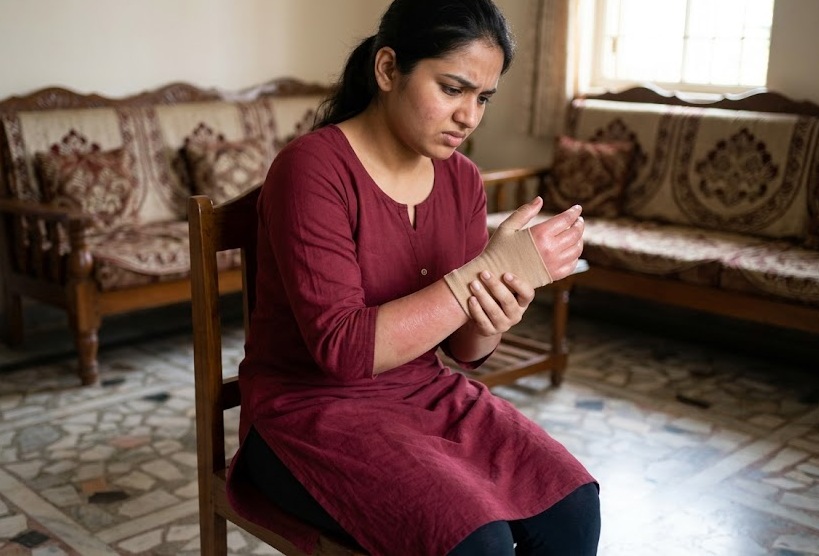
TL;DR — Understanding CRPS at a Glance
Complex Regional Pain Syndrome (CRPS) is a severe, chronic condition where a minor injury triggers a massive nervous system malfunction, resulting in disproportionate burning pain, swelling, and skin changes in the affected limb. Because the condition worsens rapidly over time, early diagnosis is critical. Treatment requires a highly specialized, multidisciplinary approach—such as the one at IBAP Clinics—combining physical therapy with advanced interventions like sympathetic nerve blocks and Spinal Cord Stimulation (SCS) to “reset” the nervous system and restore function.
Imagine burning your hand on a hot stove. Normally, the pain is intense but predictable it reflects the severity of the injury, and it settles as the burn heals. Now imagine the same burning pain persisting for months or years after a minor sprain of the wrist, intensifying with the slightest breeze or gentle touch, spreading up the arm, turning the skin an unusual colour, and making the affected limb behave as though it belongs to someone else. This is the lived reality of Complex Regional Pain Syndrome (CRPS).
CRPS is a chronic, debilitating pain condition characterised by severe, disproportionate pain usually in one limb accompanied by a constellation of changes in skin colour and temperature, abnormal sweating, swelling, and impaired movement. What makes CRPS particularly challenging is not just its severity, but its apparent irrationality: the pain far exceeds what any visible injury could justify. For this reason, patients have historically been disbelieved, misdiagnosed, and undertreated for decades sometimes told the pain is “all in their head.”
It is emphatically not in the head. CRPS involves real, measurable changes in the peripheral and central nervous systems, the immune system, and the vascular system. It is recognised by the International Association for the Study of Pain (IASP), the World Health Organization (ICD-11: MB40.0), and every major pain society worldwide as a serious, biologically driven pain disorder.
Few medical conditions have accumulated as many names as CRPS each name reflecting the era’s limited understanding of the condition’s true nature. Understanding this history is important not only for historical completeness, but because many patients in India still present with these older diagnoses written in their medical records.
| Historical Name | Era / Origin | Why the Name Changed |
|---|---|---|
| Causalgia | 1864 — Silas Weir Mitchell (American Civil War physician) | Described burning pain after nerve injury in soldiers; from Greek kausos (heat) + algos (pain). Now: CRPS Type 2. |
| Sudeck's Atrophy | 1900 — Paul Sudeck (German surgeon) | Described bone demineralisation (osteoporosis) on X-ray in painful post-traumatic limbs. Name limited to the skeletal finding; did not capture full syndrome. |
| Algodystrophy | Mid-20th century — European literature | Emphasised pain (algo) and dystrophic (tissue breakdown) changes. Still used in some European countries and older Indian medical records. |
| Post-Traumatic Dystrophy | Mid-20th century | Highlighted the trauma trigger; did not account for spontaneous onset or cases without clear injury. |
| Shoulder-Hand Syndrome | 1940s–1970s | Described CRPS following myocardial infarction or stroke; now recognised as a subtype rather than a distinct condition. |
| Reflex Sympathetic Dystrophy (RSD) | 1940s–1994 | Proposed a reflex arc involving the sympathetic nervous system as the mechanism. Though sympathetic involvement is important, many CRPS cases have pain that is not sympathetically maintained — hence the name was abandoned. |
| Sympathetically Maintained Pain (SMP) | 1980s–1990s | Described pain maintained by sympathetic activity; now understood as a feature of some CRPS cases, not a synonym. |
| Complex Regional Pain Syndrome (CRPS) | 1994 — IASP consensus (Stanton-Hicks et al.) | Deliberately neutral, descriptive term capturing the complexity, regional distribution, and pain-centred nature without assuming mechanism. Endorsed by IASP, WHO, and all major pain bodies. |
📋 For Indian Patients: What This Means for Your Records
If your medical records contain a diagnosis of RSD, Sudeck’s atrophy, algodystrophy, causalgia, or post-traumatic dystrophy, these are older names for what is now called CRPS. The treatment principles are the same. Please bring all old records to your consultation at IBAP Clinics historical documentation helps us understand your timeline.
In 1994, the IASP divided CRPS into two subtypes based on whether a peripheral nerve injury can be identified:
(formerly Reflex Sympathetic Dystrophy / RSD): Develops after a noxious event commonly a fracture, sprain, surgery, or immobilisation without confirmed damage to a named peripheral nerve. This accounts for approximately 90% of CRPS cases.
(formerly Causalgia): Develops following confirmed injury to a peripheral nerve (e.g., median nerve injury after wrist fracture, sciatic nerve injury after hip surgery). The clinical features are identical to Type 1; only the history of nerve injury distinguishes them.
Both types are managed with the same interventions. The distinction is primarily academic and matters for mechanistic research rather than clinical treatment decisions.
CRPS is not a simple problem with a single cause. It arises from a perfect storm of dysregulation across multiple biological systems an exaggerated and self-perpetuating response to injury that refuses to switch off. Understanding these mechanisms helps explain why treatment must target multiple systems simultaneously.
After injury, peripheral nerve endings (nociceptors) become hypersensitive. In CRPS, this sensitisation persists and amplifies far beyond the normal healing period. Sodium channels on nerve fibres multiply abnormally, reducing the threshold needed to fire a pain signal. Even a light touch like a gentle breeze or the weight of clothing activates pain fibres that should only respond to genuinely damaging stimuli. This is allodynia: pain from a stimulus that should not cause pain.
The spinal cord and brain also reorganise abnormally in CRPS. The dorsal horn of the spinal cord the pain relay station becomes “wound up,” amplifying every incoming signal. This is central sensitisation. Functional MRI studies show that in established CRPS, the brain’s somatosensory cortex the area that maps the body actually shrinks and reorganises the representation of the affected limb. This explains why CRPS patients often feel that the affected limb “doesn’t feel like mine” the brain has literally altered its map of the body.
The sympathetic nervous system controls blood vessel tone, sweating, and skin temperature. In CRPS, abnormal coupling develops between sympathetic nerve fibres and pain fibres essentially, the body’s “fight-or-flight” system starts directly driving pain signals. This produces the characteristic skin colour changes (red, blue, or mottled), temperature differences between the affected and unaffected limb, and abnormal sweating (hyperhidrosis or anhidrosis).
CRPS involves elevated levels of pro-inflammatory neuropeptides particularly Substance P and calcitonin gene-related peptide (CGRP) in the affected tissues and spinal fluid. Mast cell activation and microglial sensitisation perpetuate local and central inflammation. Elevated autoantibodies against adrenergic receptors have been identified in some CRPS patients, suggesting a potential autoimmune component.
The motor cortex is also affected in CRPS. Patients commonly experience difficulty initiating movements, involuntary tremor, dystonia (fixed abnormal postures), and weakness disproportionate to any structural cause. Brain imaging studies show reduced cortical motor representation of the affected limb.
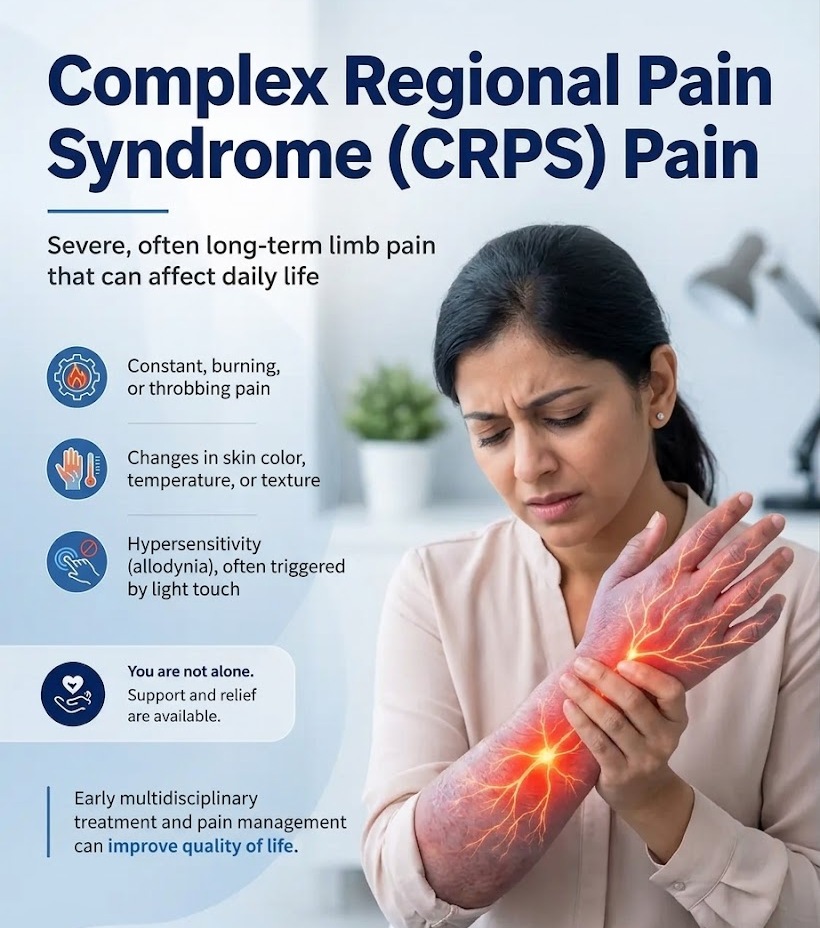
CRPS presents differently in every patient, but the following features are the hallmarks. The severity can range from manageable to profoundly disabling.
The defining feature of CRPS is pain that is out of all proportion to the original injury. Patients describe it as burning, searing, or electric in quality often compared to having the limb constantly held over a flame. Even the gentlest contact, a change in ambient temperature, emotional stress, or loud noise can trigger or intensify a pain episode.
While not all patients progress through all stages, the classical description of CRPS evolution remains clinically useful as a framework.
CRPS responds dramatically better when diagnosed and treated in Stage 1. Every month of delay allows central sensitisation and neuroplastic changes to become more entrenched. If you or a family member has burning, disproportionate pain in a limb after injury or surgery — do not wait. Seek specialist assessment immediately.
There is no single blood test, scan, or investigation that diagnoses CRPS. It is a clinical diagnosis made by a specialist who carefully evaluates the pattern of symptoms and signs. The internationally validated Budapest Criteria (Harden et al., 2010) are used worldwide and require the following:
Prerequisite: Pain that is disproportionate to the inciting event, affecting part or all of a limb.
Required: At least one symptom in three of the four categories, AND at least one sign in two of the four categories (a sign must be observed at the time of clinical examination).
Supporting investigations though not diagnostic alone include triple-phase bone scintigraphy (bone scan), thermography, plain X-rays showing Sudeck’s osteoporosis, and skin temperature testing. MRI may reveal bone marrow oedema in early CRPS.
CRPS demands a multimodal strategy — no single treatment is sufficient. At IBAP Clinics, the treatment ladder is staged from conservative through to advanced interventional therapies, guided by response at each step.
Physiotherapy and graded motor imagery (GMI) form the cornerstone of CRPS management. Pain-free movement desensitises peripheral nerves, reverses central sensitisation, and reconstructs the brain’s cortical map of the affected limb. Mirror therapy using a mirror to create the visual illusion that the affected limb is moving normally has Level II evidence for reducing CRPS pain and is a key component of the GMI programme at IBAP Clinics.
| Procedure | Mechanism | Evidence Level | Best For |
|---|---|---|---|
| Stellate Ganglion Block | Interrupts sympathetic activity to the upper limb | Level II–III | Upper limb CRPS, sympathetically maintained pain |
| Lumbar Sympathetic Block | Interrupts sympathetic supply to the lower limb | Level II | Lower limb CRPS with vasomotor features |
| IV Ketamine Infusion | NMDA receptor antagonist; reverses central sensitisation | Level II | Severe, refractory CRPS; high allodynia |
| Spinal Cord Stimulation (SCS) | Modulates dorsal horn pain processing via epidural electrodes | Level I–II | Established CRPS unresponsive to other measures; CRPS Type 1 and 2 |
| Dorsal Root Ganglion Stimulation (DRG-S) | Targets specific nerve roots at DRG level; more focal than SCS | Level II | CRPS with focal limb distribution; foot and knee CRPS |
| IV Immunoglobulin (IVIG) | Modulates autoimmune component; anti-nociceptive | Level III | Refractory CRPS with autoimmune features |
The landmark RSDSA-sponsored RCT (Kemler et al., NEJM 2000) demonstrated that SCS combined with physiotherapy was significantly superior to physiotherapy alone for CRPS pain and global perceived effect. Subsequent studies, including the ACCURATE trial for DRG stimulation, confirm neuromodulation as the most powerful tool available for severe, established CRPS. At IBAP Clinics, our Fellowship in Neuromodulation training ensures patients receive the full breadth of stimulation options — from conventional SCS to advanced waveforms and DRG-S.
CRPS presents differently in every patient, but the following features are the hallmarks. The severity can range from manageable to profoundly disabling.
After changing into an OT gown, you will have an intravenous cannula placed, vital signs and blood glucose monitored, and the injection site prepared under sterile conditions. For sympathetic blocks, fluoroscopic guidance confirms correct needle placement at the stellate ganglion (C6 level, anterior approach) or lumbar sympathetic chain (L2–L3 vertebral level). You will receive local anaesthesia and mild sedation if required. Full general anaesthesia is neither necessary nor desirable — remaining responsive allows you to report any unusual sensations that guide the procedure safely.
Start your journey with a virtual consultation to discuss symptoms from home.
We review your medical history and relevant reports for a clear understanding.
Our doctors conduct a thorough assessment through detailed discussions.
We confirm findings with state-of-the-art imaging like X-rays, CT scans, and MRIs.
Our team identifies the root cause and key trigger points for treatment.
We create a customized treatment plan, including necessary medications and procedures.
Our Pain Specialists support a complete recovery focused on total wellness.
We provide ongoing follow-ups tailored to each treatment plan, ensuring continuous care and long-term recovery support.
We relieve your pain, helping you be yourself again!
CRPS duration is highly variable. In children and adolescents, remission rates are high (up to 90%) with aggressive physiotherapy. In adults, outcomes vary: some achieve remission, particularly with early intervention; others develop chronic CRPS requiring long-term management. Duration is significantly influenced by time to diagnosis and initiation of appropriate treatment.
Yes — surgical procedures are one of the most common triggers, particularly orthopaedic surgery (wrist fracture fixation, knee surgery, hip replacement) and nerve injury during procedures. This does not mean surgery caused negligence; some individuals have a biological predisposition to developing CRPS. Vitamin C supplementation after wrist surgery reduces incidence.
No — while both are chronic pain conditions involving central sensitisation, they are distinct diagnoses. CRPS is regional (affecting one or two limbs), associated with autonomic and trophic changes, and usually follows a specific injury or trigger. Fibromyalgia is widespread, associated with fatigue and sleep disturbance, and has different diagnostic criteria. However, some patients have features of both conditions.
SCS does not cure CRPS — it significantly reduces pain intensity and improves quality of life, allowing better engagement with physiotherapy and rehabilitation. The KEMLER trial (NEJM) showed that SCS produced at least 50% pain reduction in over 60% of CRPS patients at 6 months. Some patients achieve long-term excellent control; others may require reprogramming or supplementary treatments over time.
Some prevention strategies have evidence: Vitamin C (500 mg/day for 50 days) after wrist fracture reduces CRPS incidence. Early mobilisation after injury or surgery, minimising immobilisation, and prompt management of neuropathic pain features after injury or surgery are key preventive strategies. If you have had CRPS before, inform your surgeon before any planned procedure.
Yes — epidemiological studies report a female-to-male ratio of approximately 3:1 for CRPS. The peak incidence is in middle-aged adults (40–60 years), although CRPS can occur at any age, including in children. The reasons for the sex disparity are not fully understood but may relate to hormonal influences on pain processing.
Yes, absolutely. RSD (Reflex Sympathetic Dystrophy) is one of the former names for what is now called CRPS Type 1. The condition, its symptoms, and its treatment are identical. The name changed in 1994 because the older term implied a mechanism (reflex sympathetic involvement) that does not apply to all patients.

EXCELLENTTrustindex verifies that the original source of the review is Google. Good pain relief with treatmentPosted on GoogleTrustindex verifies that the original source of the review is Google. Best for pain reliefPosted on GoogleTrustindex verifies that the original source of the review is Google. बहुत अच्छा लगा हमें ये ट्रिटमेंट करा के अच्छे डॉक्टर और अच्छे स्टाफ हैं और काम पैसे में अच्छा अच्छा ट्रिटमेंट होता हैPosted on GoogleTrustindex verifies that the original source of the review is Google. Very nice, good and helpful staf, overall good experiencePosted on GoogleTrustindex verifies that the original source of the review is Google. Very good doctors and good tritment Thank you doctorPosted on GoogleTrustindex verifies that the original source of the review is Google. One of the best clinic for the relief of back painPosted on GoogleTrustindex verifies that the original source of the review is Google. Very good treatment indo british clinic for every pain reliefPosted on GoogleTrustindex verifies that the original source of the review is Google. I have visited indo british pain clinic this is superb clinic for pain relief that's why I have given 5 start rating to this clinic ...Posted on GoogleTrustindex verifies that the original source of the review is Google. My name is Raja Sekhar Reddy Tummuri from kakinada city My father was suffering nervous pain from last 3 years … I have decided to join with this op … Now everything fine after treatment done from DR. vijay sir … Wonderful service received from INDO British advanced pain clinic Hospitals in Hyderabad @ Banjara Hills road no 12.. Each and every staff response , concern , support & everything it’s too good Thank you so much … Special thanks to Mr. DR. Vijay bhaskar Bandi Katla …👏🏻👏🏻👏🏻👏🏻🙏🙏Verified by TrustindexTrustindex verified badge is the Universal Symbol of Trust. Only the greatest companies can get the verified badge who has a review score above 4.5, based on customer reviews over the past 12 months. Read more

MBBS, DA, FRCA (UK), FFPMRCA (Pain Medicine, RCOA, UK)
CCT (Anesthesiology And Pain Management)
Neuromodulation & Advanced Pain Research Fellowship (London), MBA (HM)
Banjara Hills
2nd Floor, 284/A, Road No. 12, above IDFC First Bank, near Omega hospitals, MLA Colony, Banjara Hills, Hyderabad, Telangana 500034.

Indo-British Advanced Pain Clinic © 2026. All Rights Reserved. Designed & Developed By Adroit
WhatsApp us